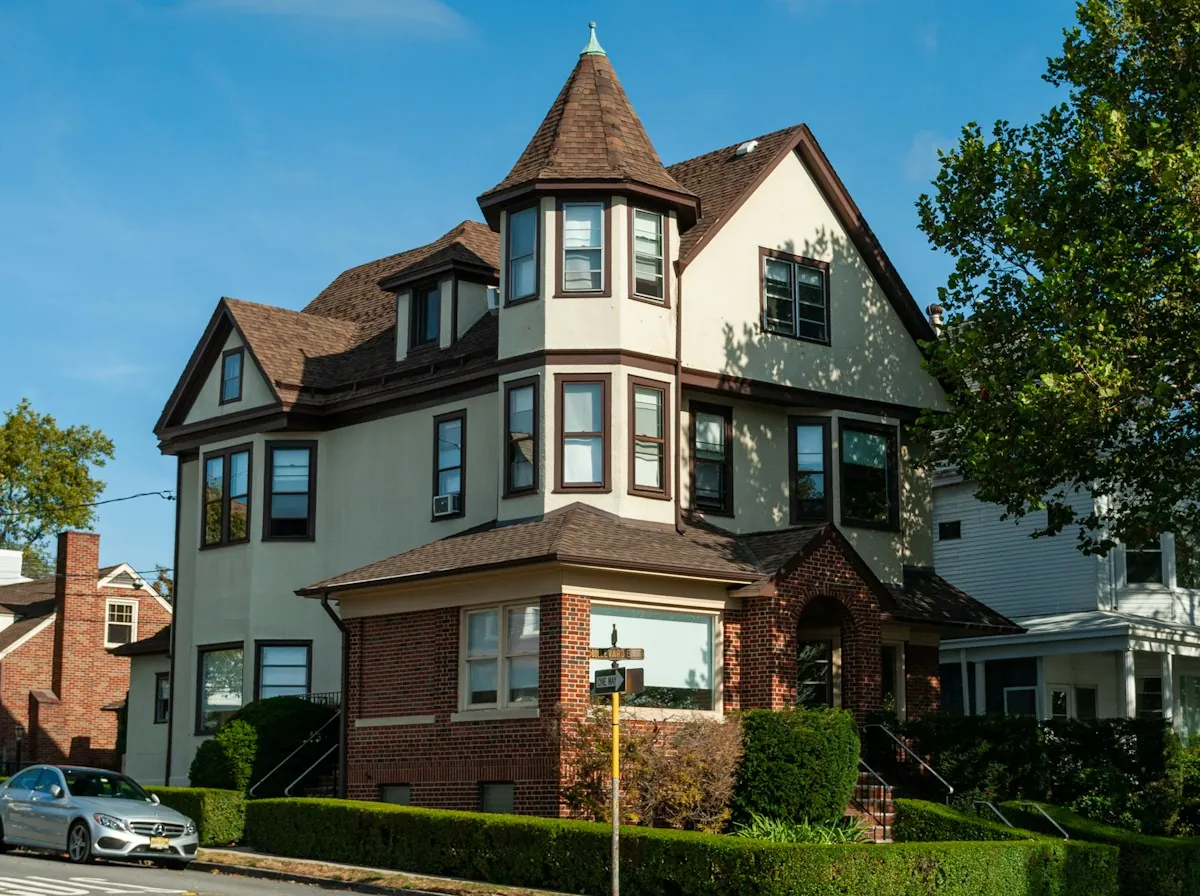
Roof Replacement in Yantacaw, typically $9,500 - $26,000. Heavy canopy. Valleys, gutters and shaded slopes. Local crew, a free written quote, and the permit pulled through the Nutley construction office.
Tree cover is the local factor. Debris packs into valleys, gutters fill between clearings, and shaded slopes stay damp long enough to grow moss. None of it dramatic, all of it shortening a covering that would otherwise have years left.
Under this much canopy, valley detail and gutter capacity are worth more attention than the choice of shingle.
The central part of the township around Yanticaw Park, with the brook running through it and heavy mature tree cover over the surrounding streets. Older detached housing with more architectural character than the later sections -- steeper pitches, dormers, enclosed porches -- under a substantial canopy.

6 lanes of roofing work, each priced against a written scope.
Under this much canopy the replacement has to solve drainage as well as covering.
Under mature trees the recurring repair is not a hole -- it is a valley.
Under heavy canopy the emergency is as likely to be a limb as the weather.
A flat roof under mature trees is a debris trap, and a blocked outlet on a low-slope deck does not overflow harmlessly the way a gutter does -- it ponds until it finds a seam.
Debris collecting behind a chimney on a shaded slope keeps the saddle permanently damp, and that is where the flashing goes first.
Under this canopy the inspection pays attention to the shaded slopes, the valleys and the gutter runs, because that is where a roof in this section ages first.
Nearly all of it is visible from the ground or an upstairs window, and the time to look is before the final payment.
Shingle lines that wander, or exposure that changes from one course to the next, mean nobody snapped a chalk line. And any nail head visible on the exposed part of a tab is a hole in your roof with a small metal plug in it. Both are countable rather than arguable.
There should be a starter strip under the first course at the eaves AND up the rakes; where there is not, the first course sits proud with daylight under its cut edge. At the top, an architectural roof should have proper cap shingles -- three-tab cut into squares is thinner and cheaper.
Valleys want metal underneath rather than a bead of sealant doing the work. Fresh caulk on weathered metal at a chimney means the flashing was reused rather than replaced. And run a hand along the eaves behind the gutter: a missing drip edge is common, cheap to leave out and completely hidden.
One township, one office. The walkaround is the point.
Plain roofs, where sloppy work shows up fastest.
Capes with rooms in the roof. Ventilation first.
Mixed use and multi-family. Unit count decides it.
The oldest stock. Board decking and second layers.
The avenue: parapets, drainage, tenants below.
Published ranges and straight answers, before you ring round.
Questions with checkable answers. How many nails per shingle and where -- a real roofer answers immediately and quotes the manufacturer's pattern. Is a starter course included at the rakes as well as the eaves. Is the ridge proper cap shingle or cut three-tab. Is the decking priced per sheet or as a lump. Is there a registration number on the document. Vague answers to specific questions are the signal; and afterwards, the roof itself either shows those things or it does not, which is why the walkaround matters more than any conversation beforehand.
For a standard asphalt roof on an average house here, yes -- that is well above the $12,000 to $18,000 most 2,000 square foot houses cost. It is not unreasonable for a large or steeply pitched house, a roof with a lot of valleys and dormers, or slate. The number alone does not answer the question; what the quote itemizes does. If it does not break out area, tear-off, decking and the details, no figure can be judged either way.
Usually not, on a house. Replacing the roof COVERING on a detached one- or two-family dwelling is ordinary maintenance under N.J.A.C. 5:23-2.7 -- no permit, no notice, no inspection. Nutley has a good deal of two-family housing, so that covers most of the township. Three or more units, an attached building, or anything structural under the covering is a different answer. Unlike most of this county there is one construction office for the whole of Nutley, so there is only one place to ask.
Eight of them are visible without climbing anything. Shingle courses that wander, or exposure that changes from row to row -- nobody snapped a chalk line. Nail heads showing on the exposed face of a tab, each of which is a hole with a metal plug in it. No starter course under the first row at the eaves or up the rakes. Ridge cap made from three-tab cut into squares on an architectural roof. Valleys with sealant instead of metal. Fresh caulk on old flashing at the chimney, meaning it was reused. No drip edge behind the gutter. And nails and debris left in the garden. Look for all eight before the final payment, not after.
Anything on the snag list put right before you pay it. New Jersey figures, not a national calculator.